The action: The key to increasing speed in a project is not to work faster, but to remove the waste of waiting between each step.
The long form: Speed is an untapped superpower in most organisations. We talk about quality and price, but rarely about the enormous advantages brought on by being fast.
Traditional business processes have the capacity to hide vast inefficiencies without anyone noticing. People just assume that a typical process takes days or weeks to complete. They don’t realize that a lean process might accomplish the same thing in a matter of hours or even minutes.
– The Toyota Way by Jeffrey Liker
The joys of being fast
Let’s look at job applications: For most positions it can take weeks after the application deadline before you hear back from the company. You attend an interview, wait a few weeks, attend another interview, and finally —after months of waiting— you have an offer. So it goes, and everyone assumes it just has to be this slow.
Contrast this to McKinsey’s process: Five interviews in one day, and an offer the same evening.
The message this sends is that “We are efficient, we expect you to be too, and we will do everything in our power to help you be your best.” While the message the slower company sends is that “we don’t expect too much of our new employees”. The lack of speed means they may also lose out on good candidates. For many, these are unfortunately hidden costs.
Does it take weeks to process your application? No. Perhaps it takes half an hour. The remainder of that time you and the application are merely waiting. No value is being added, and the process does not move.
Or look at production. Imagine it takes 18 months from when you order raw materials until the product is ready for sale. Contrast with a company that orders and produces on the same day. The slower company would have to guess what demand would look like far into the future, build up huge reserves and incur higher costs of storage. If they misjudged demand they may have to sell at a discount. If there was a production error, they may have to scrap huge amounts of valuable goods.
All the time while their more nimble competitor can turn out new product features faster and get away with less working capital and better return on investment than their slower counterpart. Faster brings with it a host of advantages.
The way to being fast: One-piece flow
The road to fast does not go through the lands of telling people to hurry up. Real progress can only be made, as Toyota discovered, by seeing all the steps in a process as one, and by targeting the waiting time between the steps.
Below is a typical work arrangement, let’s say for recruiting. The first person looks at the application, sends it off to the next person. The application waits in the email inbox, until he is ready to look at it, and then it is sent off to the last person who will also look at it in a few days time.

The solution is to work towards “one-piece flow“. Pick up one —and only one— piece of work, and hand it off into the hands of the next person, preferably sitting beside you. No one is working any faster, but the work gets done in minutes, rather than weeks.
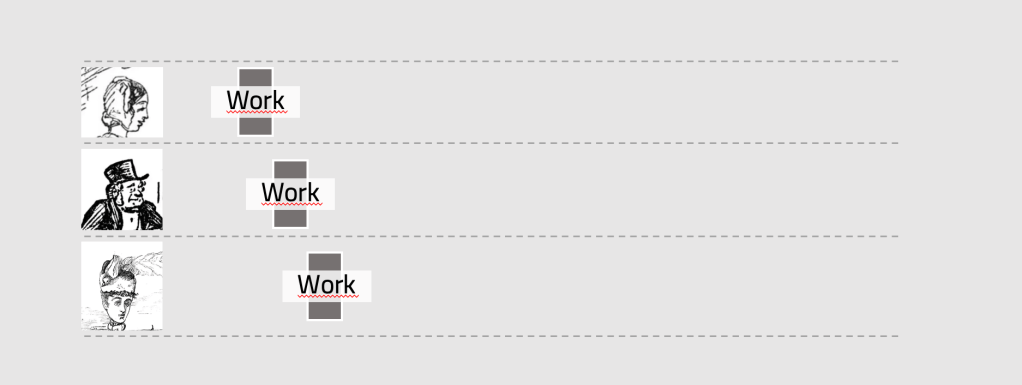
But while the advantages are hidden, the disadvantages may be all to clear: It feels like waste for a group to set aside time for working together when they have other pressing issues on their agendas. What if one person’s work is blocked, say if person 2 in the illustration cannot access the salary database? If you ask Toyota, it is the lesser of two evils:
If some problem occurs in one-piece flow manufacturing then the whole production line stops. In this sense it is a very bad system of manufacturing. But when production stops everyone is forced to solve the problem immediately. So team members have to think, and through thinking team members grow and become better team members and people.
—Teruyuki Minoura, former President, Toyota Motor Manufacturing, North America, via The Toyota way by Jeffrey Liker
You may have wasted people’s time, but you have surfaced an issue! So the next time you are recruiting, you are less likely to run into this again. And after all, the total time spent is still less than by business as usual.
Summing up: If you work on a project involving several people – try to put everyone next to each other and get the work done without any waiting time.
See also:
 First Forty