The action: To focus your strategy, be clear on what you are saying no to.
The long form: It’s always easier to say yes. Our company will offer a full range of products to every thinkable customer. We will be everything for everyone.
And even if we have a more focused strategy, is everyone in the company able to say what we are and what we are not?
Being clear on what you are not going to do often helps you be clearer on what you will say yes to. And those conscious choices lie at the core of strategy. In the words of Roger Martin from the University of Toronto, strategy is a set of answers to the questions “Where will we play? How will we win?”
Saying yes is comfortable. But it really is saying no that leads us to a strategy that is different from everyone else’s. After all, we cannot expect better results by doing the same as everyone else does.
The reason saying no is so hard, is that the things we turn down are all good things. By saying no we will stop serving paying customers, we won’t develop some of those useful product features and we will watch our competitors make money on something we too could have done.
Strategy always involves giving up something to get something else better.
Roger Martin
If it’s any consolation, there is no requirement to have perfect knowledge of exactly what is worth saying no to. But what is the smallest experiment you could run today?
McDonald’s says no to sit-down meals with cutlery and plates.
Boeing says no to planes smaller than 100-seaters.
McKinsey says no to other professional services than consulting, such as auditing or law services.
Illustrate it
A good illustration can help everyone agree on what you are doing differently to your competitors. In Mauborgne and Kim’s Blue Ocean Strategy they suggest framing the customers’ options on a strategy canvas:
For each factor of competition, map the magnitude of the competitors’ offering. Then you decide where you will offer more, less or even nothing at all. Also, are there completely new features you will add?
Below is an illustration of Southwest Airlines, one of the early low-fare carriers. Note how radically different its offering is from the existing airlines, with less of the traditional amenities such as meals, but more of other features such as friendly service, speed and more frequent departures. The more different your strategy, the more clearer your position will be in the eyes of customers and staff.
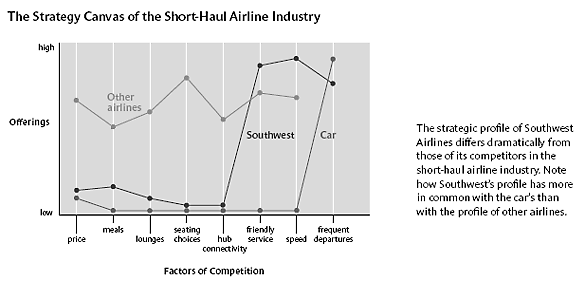
On a side note: See how they looked at the customers’ options more broadly, and included car travel as relevant competition. Sodastream, producer of fizzy-drink machines for home use, initially saw their competitors as other producers of fizzy-drink machines. Their market share was huge, so there was not much more to gain. However, they eventually realized that the real competition was the total market for sodas, and that their market share compared to Pepsi or Coca-Cola was tiny. This lead them to shape up their strategy and grow at a faster rate.
So be like Steve Jobs, and say no to more things:
I came out of a meeting with [the engineering team] who had just got their product cancelled and they were three feet above the ground with excitement, because they finally understood where we were going and they were really excited about the strategy
Steve Jobs, 1997
 First Forty