The action: One of the most important questions you can ask yourself and the team is: “What is getting in the way of our doing work we are proud of?”
The long-form:
12a. Remove barriers that rob people of pride of workmanship.
W. Edwards Deming, Out of the Crisis – 14 Principles of Transformation.
Every organisation unwittingly creates obstacles to doing good work. As companies grow, complexity creeps in. As regulation tightens and management becomes more risk-averse, new rules are introduced. Communication fails, so no-one even knows what constitutes quality work. And sometimes we make people work with low-quality tools or poor raw materials.
You can run all the motivational workshops you want, but the best way to attract and keep skilled people is to make it easy for them to do a great job with other great people.
Make it your mission to place yourself in their shoes and seek out and remove complexity from their everyday work.
- Spend time on the front lines. Be a helicopter manager – not in the sense of hovering over people, but by being able to fly at a range of altitudes. Go down into the details but also up to the birds-eye perspective. Talk with your team often, and perhaps even just observe how they work. Good strategy often comes from the details of everyday work. The people closest to production or the customer will usually know about opportunities that aren’t found in your PowerPoint decks. Being interested is not micromanaging, and laissez-faire is not leadership.
- Try doing the work of your staff. Jump through all the hoops of their main job, or even just an administrative task such as their on-boarding experience. Take note of where there are barriers. David Singleton of Stripe calls this friction logging (link via Jess Peterson). Make it your goal to fix these.
- Ask your team for ways to reduce complexity (f40). Place these suggestions high up on the list of possible weekly improvements, and put your weight behind coaching a solution.
- Find peers and bosses who also want to change the company’s convoluted processes. Going at it alone is likely to fail, but build an alliance and you are more likely to be able to simplify the rules.
- Look again into the business case of improving the tools. Buying faster computers, developing better training, templates or software pays dividends not only on the work itself, but on employee retention and satisfaction.
- Check if everyone knows what great work looks like. Does everyone know what constitutes a high-quality product, great customer service, an efficient process?
- Where possible, let the team set their own standards. For example, ask what they think a good limit for customer waiting time should be. They are usually at least as eager to please the customer as you are.
- Don’t be afraid of stretch goals. People usually meet expectations, whether high or low. And you’ll likely find that your team’s self-defined goals are more ambitious than yours.
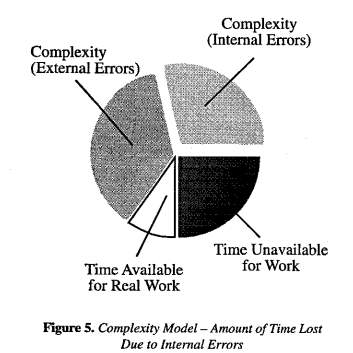
Read more: Timothy Fuller’s 1986 article on Eliminating Complexity from Work is still great!
[…] in most processes in our offices and factories where no long-term process improvement efforts have been in place, most of the activities undertaken by people are part of the complexity and few activities represent “real work” that people would like to be doing.
Timothy Fuller
To come: Sounds like Adam Grant’s next podcast season will be on point
 First Forty